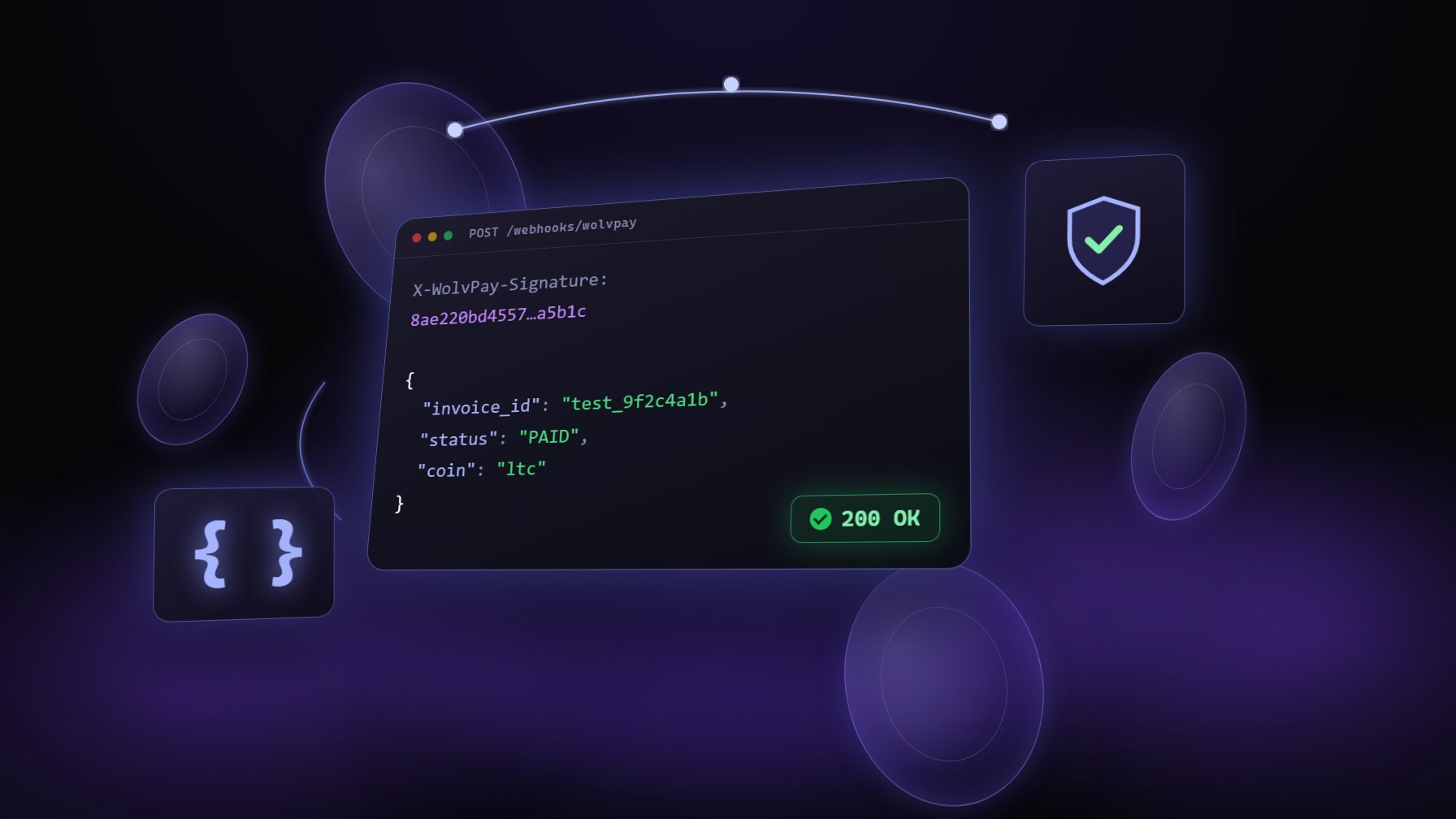
Rebuilt API Docs: A Testing Guide, Webhook Examples and Docs Your AI Agent Can Read
The WolvPay API docs have been rewritten. They now show how to test your integration, how to handle webhooks safely, and they come in formats that AI coding agents can read.
Testing, without a sandbox
WolvPay does not have a sandbox or test API keys. Your key always talks to the live service. The new Testing & Sandbox section says that plainly, then shows what you can test without spending anything:
- Your webhook endpoint with the Webhook Tester, which sends a signed sample for PAID, AWAITING_PAYMENT, CONFIRMING_PAYMENT, UNDERPAID or EXPIRED
- Your handler with no network by signing a payload yourself and posting it to localhost. There are copy-paste versions for curl, Node.js and Python
- The API itself by creating invoices. They cost nothing and expire on their own after 24 hours
- The whole path with one small real payment before you go live
There is also a 12-item checklist: duplicate deliveries, a tampered body, a missing signature, an expired invoice, an unknown invoice ID, and what your server should return when your own database is down.
Webhooks you can trust
The webhook section now has a recommended handler in Node.js, Python and PHP. Each one does the same five things in order:
- Verifies the signature on the raw request body
- Looks the invoice up through the API, so the status you act on is the real one
- Fulfills the order only on PAID, and only once
- Answers quickly with a 2xx
- Answers 5xx when your side fails, so the delivery shows as failed and you can resend it
Because it checks the invoice through the API, a Webhook Tester delivery is ignored and can never fulfill a real order. The docs also list the usual signature mistakes, such as hashing parsed JSON instead of the raw body, and describe the setup rules: HTTPS only, a real domain, no IP addresses, and up to three endpoints.
Docs for AI coding agents
If you build with Claude Code, Cursor, Copilot or ChatGPT, give it the real docs instead of letting it guess.
- openapi.json is an OpenAPI 3.1 spec with every endpoint, the response shapes and the webhook payload
- docs.md is the whole docs page as Markdown. The Copy for AI button copies it in one click
- A short list of integration rules covers the things agents most often get wrong, like inventing a test mode or trusting an unverified webhook
- A starter prompt you can paste into your agent and fill in
The quickstart examples come in cURL, Node.js, Python and PHP, and the copy button copies exactly what you see.
Corrections
While checking the docs against the API, we fixed several things that did not match:
- List invoices returns up to 25 per page, not 3
- Amounts in responses and webhooks are always in USD, whatever currency you created the invoice in
- Hosted invoices return the invoice ID and the checkout link, without a status
- The error format and the webhook payload examples now match the real ones
- Colombian Peso and Czech Koruna had swapped codes in the currency list
- The full list of coin codes is now in the docs
What you need to do
Nothing. The API and your webhooks are unchanged. Open the docs, try the Webhook Tester, and tell us on Discord if something is still unclear.

Building the future of cryptocurrency payments - 1% fees, instant withdrawals, no KYC.